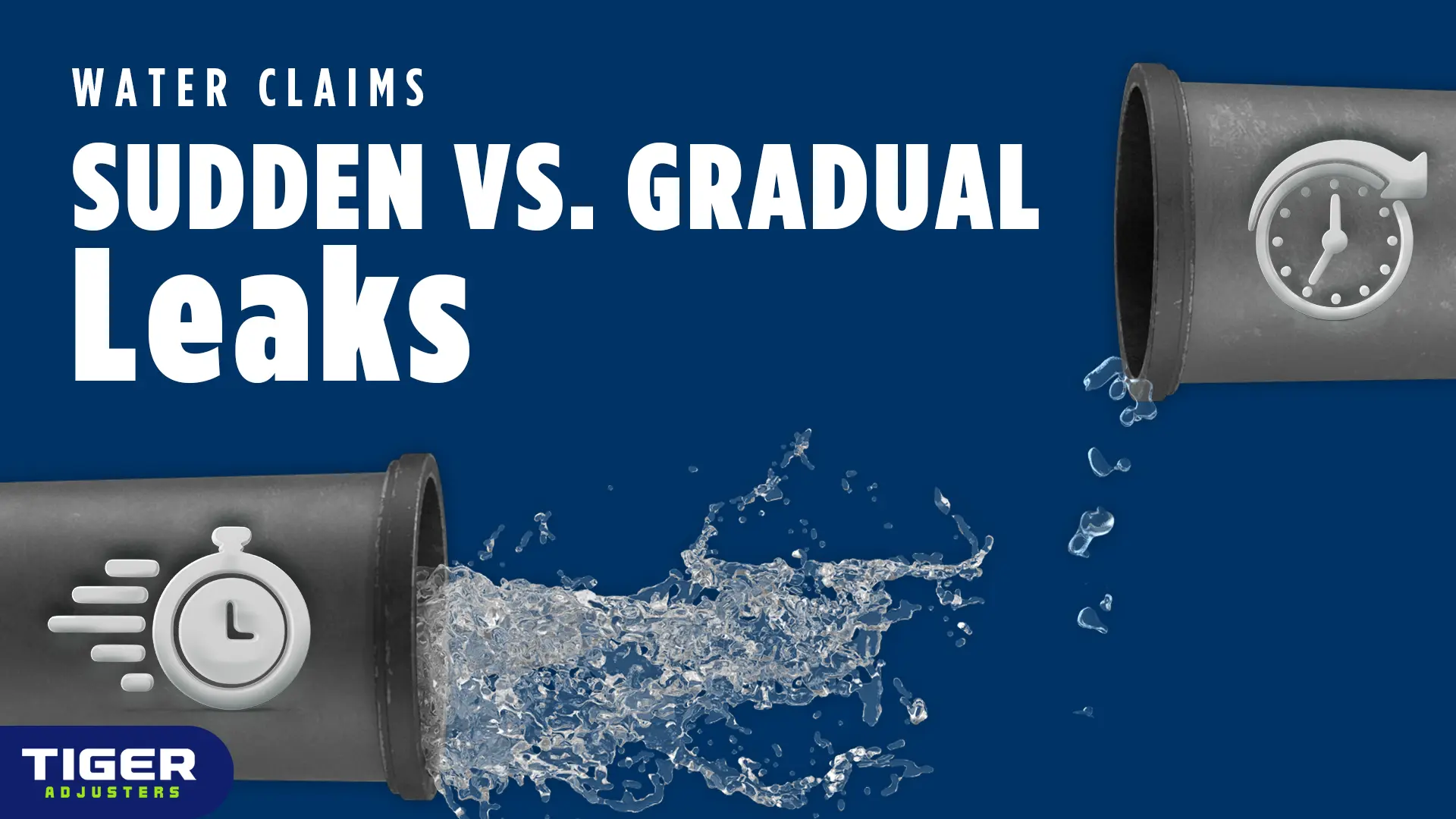
Water Damage Claims: Understanding the Difference Between Sudden vs. Gradual Leaks

Water Damage Claims: Understanding the Difference Between Sudden vs. Gradual Leaks

Steven Faunce
Steven Faunce
February 25, 2026
Public Adjusting
Claims Handling

Water damage is one of the most common types of property insurance claims. Since it is so common, it is also one of the most frequently denied. Many homeowners assume their standard policy covers all water damage, only to face claim denial due to a specific distinction: was the damage sudden and accidental, or gradual and chronic? This difference is often the most important factor that determines coverage, and it is a common clause for insurance carriers to use to undervalue or deny a claim. 

Water damage and freezing is the second most frequent cause of property loss claims, averaging 1.50 claims per 100 policies, or about 1 in 67 insured homes, annually. It also accounted for 22.6% of all incurred homeowner losses in 2023 (Insurance Information Institute, 2025). 

Why the Distinction Matters to Your Claim

The standard H0-3 homeowners policy is designed to cover sudden, unforeseen events. It typically covers damage resulting from an internal source that is sudden and accidental. It is generally not designed to cover damage from lack of maintenance or neglect, which is how insurers categorize gradual leaks.

A sudden and accidental event is one that happens unexpectedly and instantly, or over a very short, defined period. Your policy will most often cover the resultant water damage from these scenarios:

  • Burst or Ruptured Pipes: A pipe that instantly breaks due to high pressure or a freezing event. 
    • Note: In the event of a frozen pipe bursting, you must be able to prove that you took proper precautions by winterizing your home. 
  • Accidental Overflow: A washing machine hose snaps, a toilet overflows, or a water heater breaks without prior warning.
  • Appliance Malfunction: A sudden failure of an air conditioning unit or a dishwasher, causing water to escape.

In these cases, the water damage to the surrounding structure (walls, floors, ceiling) is typically covered, though the repair or replacement of the source appliance or pipe itself may not be.

The most common reason for a water damage denial is the determination that the damage was gradual, chronic, or due to seepage or continuous leakage. Insurers assume these issues should have been discovered and fixed by the homeowner as part of routine maintenance. Examples include:

  • A slow, persistent leak behind a shower wall or under a kitchen sink that develops mold over several months.
  • Water seepage through a foundation wall due to poor exterior drainage or deteriorated caulking.
  • Leaking from a worn-out roof flashing over an extended period.

In these instances, the carrier will argue the damage was preventable, which is a key exclusion in most policies.

The Insurance Policy's Language

To determine coverage, insurers look for two key phrases in the policy's exclusions section:

  • "Wear and Tear, Deterioration": This language is used to deny damage that occurred because a plumbing component simply wore out over time.
  • "Continuous or Repeated Seepage or Leakage": This directly addresses the gradual leak issue, excluding coverage if the water flow occurred over a period of weeks, months, or years.

If you experience water damage, time is your enemy. The longer a claim is delayed, the easier it is for the carrier to argue the damage was gradual. You must:

  • Stop the Source Immediately: Call a mitigation company to prevent further damage.
  • Document the Discovery: Take photos of the moment you discovered the water and any evidence suggesting the failure was sudden (e.g., a clearly snapped hose, a fresh crack in a pipe).
  • Preserve the Cause: Do not dispose of the broken pipe or appliance that caused the loss. Your Public Adjuster will need it for inspection.

Hiring a Public Adjuster Can Overturn a Gradual Leak Denial

A Public Adjuster can make sure that property owners are properly indemnified for loss, and that a fair and honest settlement is provided. In water damage cases, we bring technical expertise to challenge the carrier’s claim that a loss was gradual:

  • We use experts to determine the precise date and cause of the pipe failure.
  • We use policy language to ensure coverage is applied to the consequential damage (the wet floors and walls), even if the pipe repair itself is not covered.

Protect your home's structure and contents — contact Tiger Adjusters®.
Steven Faunce
Steven Faunce
Steven Faunce is the Owner/Operator and Public Adjuster for Tiger Adjusters® in Kansas City, MO. He spent 17 years working for a major carrier in insurance homeowner's property claims and is excited to bring this experience to representing homeowner's while developing strong relationships with each carrier
CONTACT AUTHOR

FAQ

What qualifications should I look for in a good Public Adjuster?
A state license, experience, references, good communication skills, and a fair fee structure. All of which Tiger Adjusters representatives offer.
Can I hire a Public Adjuster after I've settled with my insurance?
Yes, negotiations can be reopened, especially if you feel you've been shortchanged. Beware that state law effects the timeline for how long after a claim is closed that it can be reopened. Most claims have a five year period after closing in which they can be reopened.
Do Public Adjusters work for insurance companies?
No, Public Adjusters do not work for an insurance company. They legally work and advocate for you, the homeowner or commercial property owner (policyholder).
Troy Tiger newsletter

Unleash the Tiger!

Troy Tiger's secrets to getting what you deserve from the insurance bigwigs. All about kicking tail & settling claims.
Thank you! Your submission has been received!
! Please correct errors before submitting this form !