Growing up, did you have an older sibling or friend who stood up for you when you needed it? When you hire a Public Adjuster to handle negotiations with your insurance provider, they fill a similar role by stepping in to make sure your side of the claim is heard.
Insurance policies can be long and complex, and the claims process can be hard to navigate on your own. But this time, you’re not walking home from the bus stop alone—you’ve got a Public Adjuster to help level the playing field.
With a signed agreement in place, a Public Adjuster is authorized to communicate and negotiate with your insurance company on your behalf.
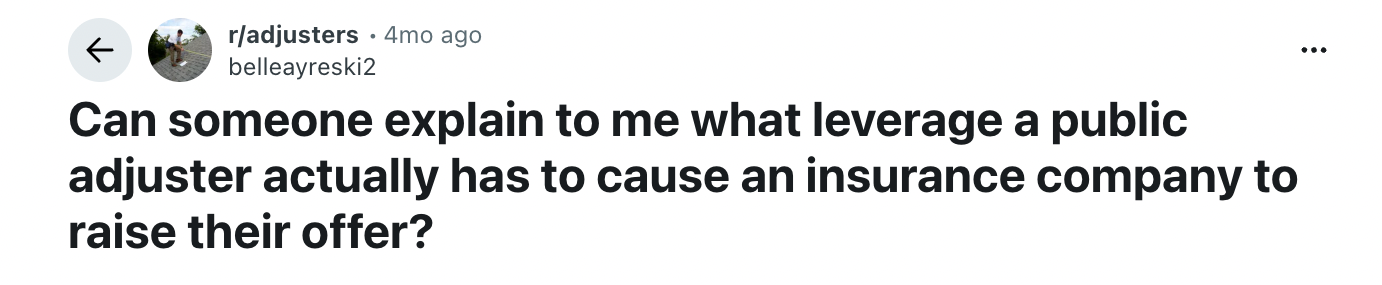
But what leverage does a Public Adjuster actually have in a negotiation with your insurance carrier? The Redditor below asked the same question.
A licensed Public Adjuster is on your team, not the insurance company’s. Their job is to review your policy, properly document your damage, prepare a detailed estimate and negotiate with the carrier on your behalf.
They cannot guarantee a larger settlement, but they can provide leverage in insurance negotiations through their breadth of knowledge and experience with the claims process.
Once you formally appoint a licensed Public Adjuster, they become your representative for the claim, subject to applicable state law and the terms of your representation agreement.
Public Adjusters have to meet licensing requirements in most states, which typically include education or training, an examination, and other state-specific requirements. Laws vary by state, and not every state allows Public Adjusters. A qualified Public Adjuster understands the rules governing insurance claims and the responsibilities that come with representing a policyholder.
Public Adjusters at Tiger Adjusters undergo additional in-house training, on top of state-required training. Read more about our in-depth training program, and get in touch for expert claim support.
One of the biggest advantages a Public Adjuster brings to claims negotiation is a detailed understanding of the policy itself.
Before estimating the damage, a Public Adjuster reviews your coverage, exclusions, limits, and other relevant policy language. The goal isn’t to find a way to inflate a claim. It’s to determine what the policy actually covers and make sure those covered losses are properly accounted for in your settlement.
A Public Adjuster worth their salt will never exaggerate damages or pad estimates above what they should be. They advocate for what the policyholder is entitled to under their policy—no more, no less. As consumer advocates, strong ethics are essential for Public Adjusters.
When you file a claim with your carrier, an insurance adjuster will come out to inspect the property and prepare an estimate. But that estimate may not always tell the whole story.
A licensed Public Adjuster conducts an independent inspection looking at the damage with a fresh set of eyes and with the policyholder’s best interest in mind. They may identify damage that was overlooked in the original documentation, incorrectly classified, or not fully accounted for in the insurance estimate.
Public Adjusters also have an in-depth knowledge of how proper repairs are performed and what materials and labor cost in the current market.
It’s not unusual for a Public Adjuster’s estimate to be higher than the insurance company’s estimate. There are several legitimate reasons for the difference, including:
The important question isn’t which estimate is higher. It’s why the estimates are different and whether the additional damage and costs are supported by the policy, evidence, and actual repair requirements.
Insurance claims involve much more than simply identifying damage. Public Adjusters work with policy language, state regulations, estimating practices and carrier procedures every day.
That experience can be particularly valuable when there is disagreement over the scope or value of a loss. A Public Adjuster can review the carrier’s inspection report, estimate and settlement offer, identify potential gaps, and provide documentation supporting a different valuation.
There is also growing attention around the way insurers use technology and automated tools when evaluating claims. Many insurers use software, AI, and other automated systems to help assess damage and estimate claim values, which has raised questions about how those tools may affect coverage and settlement decisions.
Recent lawsuits have also alleged that some major insurers improperly denied or underpaid storm claims.
Technology can be useful, but an estimate generated by software still needs to accurately reflect the actual damage to a given property.
A Public Adjuster may negotiate many aspects of a property insurance claim, including:
The Public Adjuster supports their argument with documentation, photographs, estimates, and policy language rather than simply asking the insurance company to “pay more.”
So, what leverage does a Public Adjuster really have in insurance negotiations?
A Public Adjuster can’t force an insurance company to pay something the policy doesn’t cover. But when there is legitimate disagreement about the scope or value of a covered loss, having an experienced professional to hold your carrier accountable can put you in a much stronger position.
If you’re dealing with a complicated, disputed, or potentially underpaid property insurance claim, Tiger Adjusters can help you understand your options and navigate the claims process.