
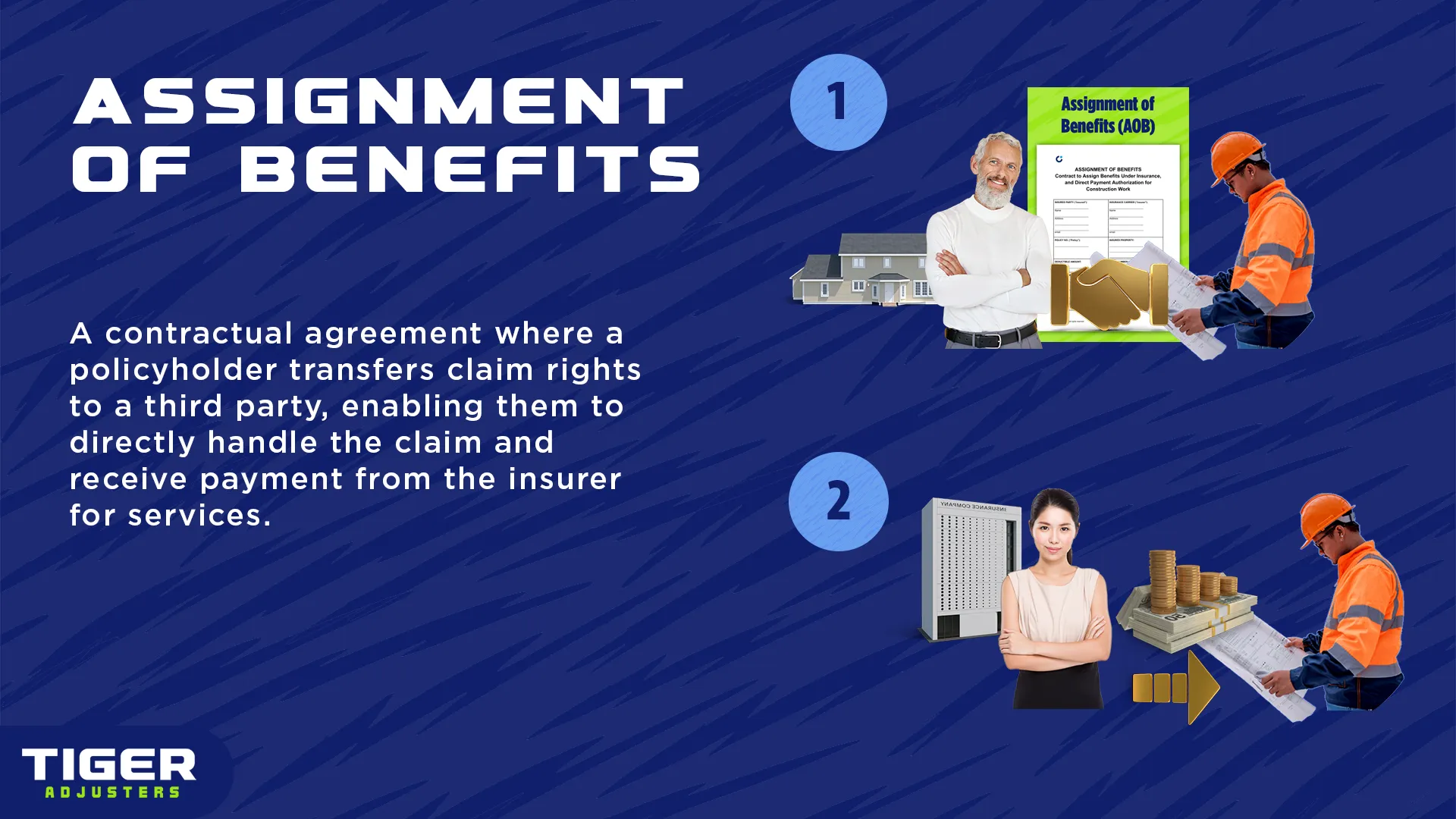
An "Assignment of Benefits" (AOB) is a contractual agreement in which an insurance policyholder transfers their rights to a claim and its benefits directly to a third party, typically a contractor, restoration company, or other service provider. This allows the third party to handle the insurance claim directly with the insurance company and receive payment directly from the insurer for services rendered.


Let's talk about the "Assignment of Benefits," or AOB! This is a pretty big deal, because it's like handing over the keys to your claim's financial pipeline to someone else.
Here's the breakdown: When you've got property damage, and you hire a third-party contractor or a restoration company, and sometimes they'll ask you to sign an AOB. What this document does is transfer your right to the insurance claim, and the money that comes from it, directly to them. So, instead of the insurance company paying you for the repairs, and then you paying the contractor, the AOB allows the insurance company to pay them directly.
It's designed to make things smoother, especially when you need emergency work done fast. The contractor can jump right in, deal with the insurer, and get paid without you having to be the middleman. However, it's crucial to understand what you're signing, because once that AOB is in play, the contractor essentially steps into your shoes for that part of the claim!
No, not every contractor will require an Assignment of Benefits. Many contractors will work with you, bill you directly, and allow you to manage the payment from your insurance company. This gives you more control over the funds.
Some contractors, particularly those specializing in emergency services like water mitigation, frequently use AOBs. In some situations, especially after widespread disasters, they can be a quick way to get work started. The average severity for claims with an AOB is about 85% more than those claims without (Verisk, 2018). However, it's critical to read every single line of an AOB very carefully. In some cases, signing an AOB could potentially lead to disputes over repair costs or even put you in a tough spot if the contractor and insurer disagree. Always be sure you're comfortable with giving up control over that part of your claim's payout!
No, definitely not! Assignments of Benefits (AOBs) vary significantly in their terms and implications and are a highly regulated, often controversial, topic. Many states have enacted specific laws to regulate AOBs due to past abuses. These laws might, for instance, limit fees, allow for cancellation periods, or restrict which rights can be assigned. Some AOBs are very narrow, covering only specific emergency services, while others can be dangerously broad, potentially assigning all claim rights related to the loss. This broader scope can be problematic. Historically, AOBs have been a source of legal disputes between insurers and contractors, sometimes leading to inflated bills or litigation where policyholders can unfortunately get caught in the middle. Always exercise extreme caution.
An Assignment of Benefits is a powerful legal document that grants significant control over your claim's financial flow. While it can offer convenience, it also carries risks. Never sign an AOB without fully understanding its terms, the specific rights you are transferring, and your potential liabilities. For complex property claims where an AOB is involved, or if you're ever uncertain, always consult with your Public Adjuster for clarification on your property rights and a legal professional for the AOB's legal implications. They’ll help you decode the contract's fine print, because a misaligned AOB can totally corrupt your claim's payout!


