Insurance Terms Glossary

Law and Ordinance

Within property insurance, "Law and Ordinance coverage" is an additional provision that helps pay for the increased costs of repairing or rebuilding your property after a covered loss, specifically when those costs are due to updated building codes, ordinances, or zoning laws. It bridges the gap between your property's value before a loss and the increased expenses incurred to bring it up to current legal standards.
Law and Ordinance

Troy Tiger Explains: Law and Ordinance 

When your house faces a major hit from a covered peril, your standard policy might rebuild it to old standards, but sometimes those local building codes sneak in new rules. That's where Law and Ordinance coverage steps in, kinda like an important update that makes sure your rebuild isn't just back to normal, but actually meets all the new legal standards. Think of it as your policy's built-in "compliance officer," providing that extra buffer so you're not left scrambling for unexpected costs.

Water damage and freezing accounted for 27.6% of homeowners insurance losses in 2022 (Insurance Information Institute). If a widespread event like that hits, you can bet local authorities will be looking at what's built to code, making this coverage incredibly important!

Law and Ordinance Coverage Purpose

  • The core function is to cover the additional expenses for materials and labor required to rebuild or repair your property to current building codes or zoning laws. Like getting a new, required, fire-resistant roof when your old one wasn't.
  • If a local ordinance requires you to demolish the undamaged portion of your building after a partial loss (because the damaged part is so extensive), this coverage can help with that cost.

How Law and Ordinance Coverage Works

  • Your property suffers damage from a peril covered by your standard policy (e.g., fire, windstorm).
  • During the assessment or rebuild planning, it's determined that local building codes, ordinances, or zoning laws require the property to be rebuilt to a higher standard than it was previously.
  • Your Law and Ordinance coverage then comes into play, providing the additional funds necessary to comply with these updated requirements beyond what your dwelling coverage would typically pay.

Does Property Insurance Always Include Law and Ordinance Coverage?

Sometimes, a basic amount of Law and Ordinance coverage (often around 10% of your dwelling coverage) might be included in a standard homeowner's policy. But here’s the kicker: that basic amount is often nowhere near enough to cover the actual costs of bringing an older property up to current codes, especially after significant damage. Insurance companies love to give you a taste, then hit you with the full bill when you're desperate. 

Good thing you have a Public Adjuster to act as your chief compliance officer, auditing those code requirements and ensuring you get every cent you need!
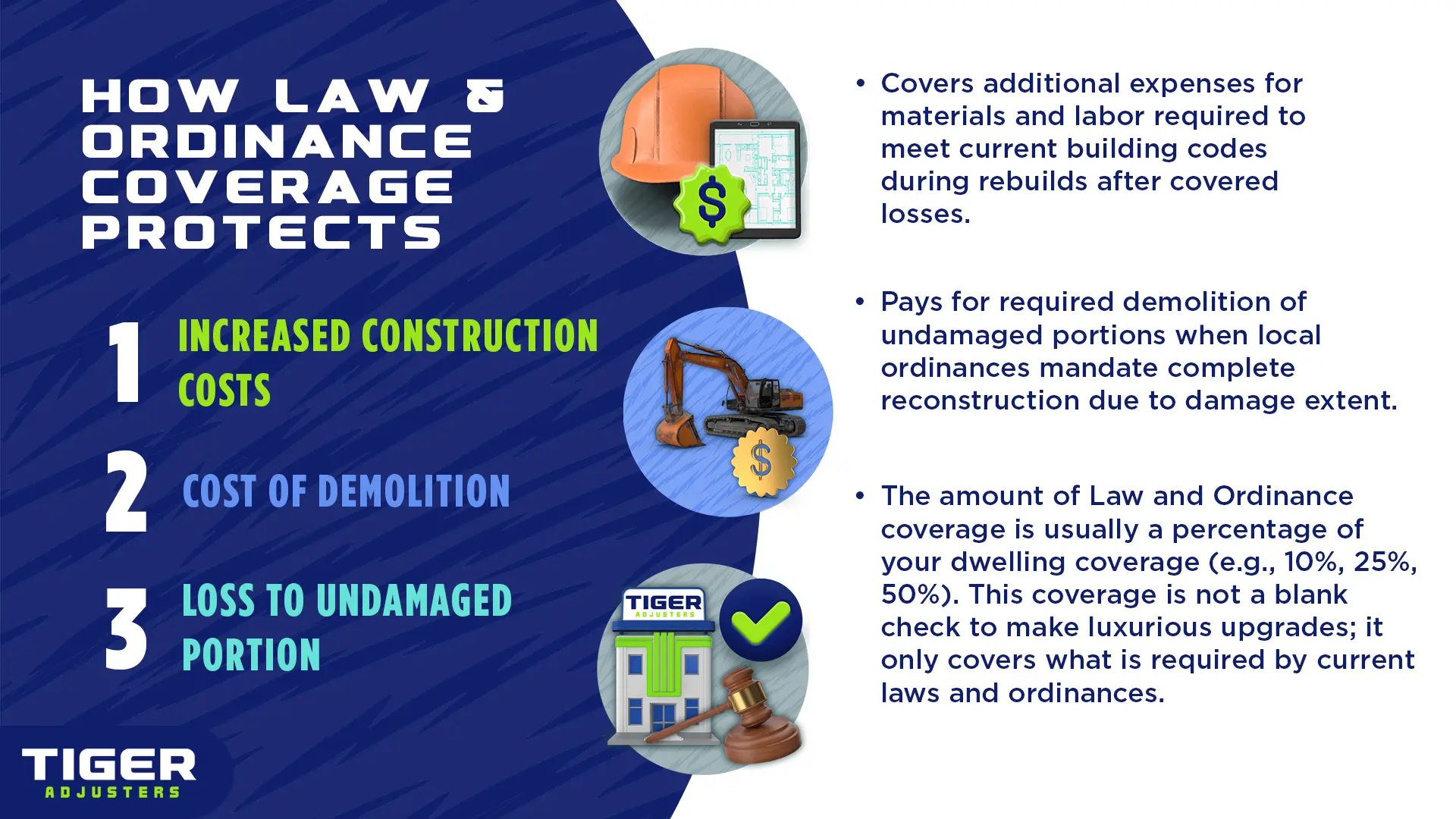
Infographic: How Law & Ordinance Coverage Protects

Breakdown of Law and Ordinance Scenarios:

  • Increased Cost of Construction:
    • This is the heart of the coverage, addressing the direct financial impact of updated building requirements.
      • Example: Your roof is destroyed by a storm. When rebuilding, new wind-mitigation codes require stronger ties and a specific type of underlayment, which are more expensive than your old roof. Law and Ordinance covers that difference.
  • Cost of Demolition:
    • This refers to the expense of tearing down both damaged and undamaged parts of a structure when a local building code dictates that the entire structure, or a significant portion, must be demolished and rebuilt due to the extent of the damage (e.g., if more than 50% is damaged, the entire building must come down
      • Example: A fire damages half your home, but the local code states if more than 50% is damaged, the entire structure must be demolished and rebuilt from scratch to current earthquake standards. This covers the demolition of the undamaged half.
  • Loss to Undamaged Portion:
    • This is less common but crucial for specific scenarios where building codes or ordinances prevent an undamaged part from being incorporated into a rebuilt structure or require its demolition/expensive modification, even if the overall damage isn't extensive enough to condemn the entire property.
      • Example: A historical district ordinance dictates that if a specific percentage of a wall is damaged, the entire wall, even the undamaged section, must be replaced with historically accurate, more expensive materials. This coverage could help.

Are All Law and Ordinance Coverages Created Equal?

Nope, and this is where the fine print becomes your most critical piece of debugging. The amount of Law and Ordinance coverage is usually a percentage of your dwelling coverage (e.g., 10%, 25%, 50%). This coverage is not a blank check to make luxurious upgrades; it only covers what is required by current laws and ordinances. 

Final Thought:

Law and Ordinance coverage is a safeguard against the hidden costs of rebuilding your property to current legal standards after a loss. Don't assume your basic dwelling coverage will cover these essential upgrades. For a thorough understanding of your policy's Law and Ordinance limits and to verify your rebuild is fully funded to meet all legal requirements, call a Public Adjuster, who excels at debugging coverage intricacies and will clarify what's actually covered in your policy.

Search for more terms