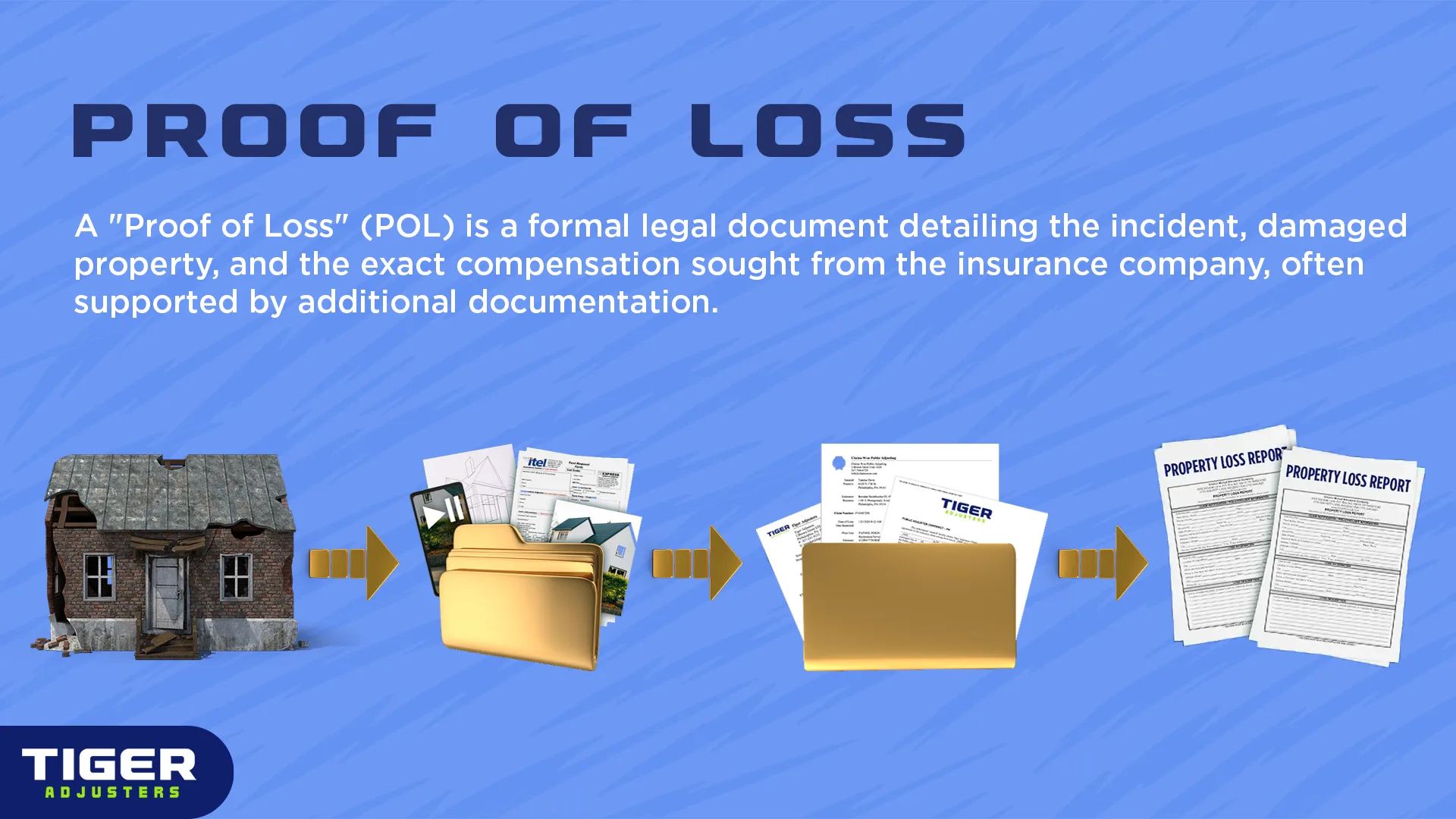
Within insurance claims, a "Proof of Loss" (POL) is a formal, legal document that details the nature of the incident, the damaged or stolen property, and the precise amount of compensation being sought from the insurance company. It's often accompanied by supporting documentation like estimates, photos, and other evidence.
Troy Tiger Explains: Proof of Loss
Let's talk about the "Proof of Loss!" This isn't just some random piece of paper; this is the master blueprint, the data sheet, the grand summation of everything you've lost. When we're building your claim, especially for property damage, the Proof of Loss (POL) is the official document we file with the insurance company.
Proof of Loss Purpose
Provides a detailed breakdown of all damaged or lost property and assigns a monetary value to each item.
Serves as a formal declaration of the amount the policyholder is claiming under the policy.
Supports Negotiations: Becomes the primary document used in negotiations between the policyholder (or their Public Adjuster) and the insurance company.
Foundation for Litigation: In cases of dispute, the POL is a key legal document.
How a Proof of Loss Works
You experience property damage or loss due to a covered peril.
Your Public Adjuster thoroughly documents all damages (photos, videos, inventory) and develops a detailed "Loss Estimate," which organizes all inspection documentation and pricing for every line item. This estimate is the foundation of your loss argument.
Based on the estimate and other evidence, the Proof of Loss document is formally prepared, detailing the claim.
The POL is submitted to the insurance company, either because the policy requires it within a certain period, or because the insurance company has specifically requested it. An extension of time can be requested if more time is needed.
The insurer reviews the POL. Negotiations then proceed based on this submitted document. You should always reserve your rights to revise your POL as new information or hidden damages become available, keeping your data updated for maximum recovery.
Does Every Claim Require a Proof of Loss?
Not every minor claim will automatically require a formal Proof of Loss right out of the gate, especially if the insurance company can quickly verify and agree to the damages. For significant losses, or if there's any dispute, your insurance company might explicitly request a POL, or your policy might require it within a specific period after the loss. This isn't optional; it's a mandatory data submission! And while they might not always ask, providing a detailed POL is always in your best interest. It’s like handing them a complete, validated data set, rather than just a fragmented file! Good thing you have a Public Adjuster who's a master at crafting these detailed reports, making sure your claim is backed by solid data!
According to Weiss Ratings, a national independent insurance rating agency, 13 large U.S. property insurers denied 40% to 70% of the 3.9 million homeowner claims they closed in 2023. Overall, these 13 providers denied payment on 47.5% of claims.
Infographic: Proof of Loss
Breakdown of Proof of Loss Components:
Policy Information: Your name, policy number, date of loss, and contact details.
Description of Loss: A concise yet thorough explanation of the incident (e.g., "Fire originating in kitchen on 2025-07-15").
Damaged/Lost Property Details: A detailed, itemized list of all damaged or stolen items (e.g., "Living Room Sofa, brand ABC, purchase date, replacement cost, depreciation, actual cash value").
Includes descriptions of structural damage (e.g., "Roof damage to entire south slope, 250 sq ft").
Amount Claimed: The total monetary amount being sought for all aspects of the loss, clearly broken down (e.g., dwelling, personal property, additional living expenses).
Supporting Documentation: References to attached documents like detailed loss estimates, contractor bids, photographs, videos, inventory lists, receipts, and police reports.
Declarations & Signatures: A formal statement, often under oath, affirming the accuracy of the information provided, signed by the policyholder and sometimes the Public Adjuster.
Are All Proofs of Loss Created Equal?
No, definitely not! While the basic format might be similar, the quality, detail, and effectiveness of a Proof of Loss can vary dramatically.
A well-prepared POL is highly detailed, accurate, and supported by extensive documentation. A poorly prepared one can lead to delays, denials, or undervaluation.
It must adhere to any specific requirements outlined in your insurance policy regarding how and when it should be submitted.
Public Adjusters specialize in preparing comprehensive POLs that are designed to withstand scrutiny from the insurance company, leading to significantly higher settlements.
Final Thought:
The Proof of Loss is the statement of your claim, the critical data packet that informs your insurer of the full extent of your damages. Don't treat it as just another form; it's the bedrock of your financial recovery. For expert preparation and submission of a POL that accurately reflects your losses and maximizes your settlement, partner with a Public Adjuster. They'll verify your claim's data is clean, complete, and unassailable, because a flawed POL can corrupt your entire recovery process!