.png)
When it comes to property damage insurance claims, depreciation is a tricky topic. Regardless of whether you have an Actual Cash Value policy or a Replacement Cost Value policy, your initial settlement offer will automatically subtract your deductible—the amount you are responsible for paying out of pocket—from the total value of your claim. From there, you may find yourself nickel-and-dimed by your insurer even further for depreciation.
Just ask this Reddit user:
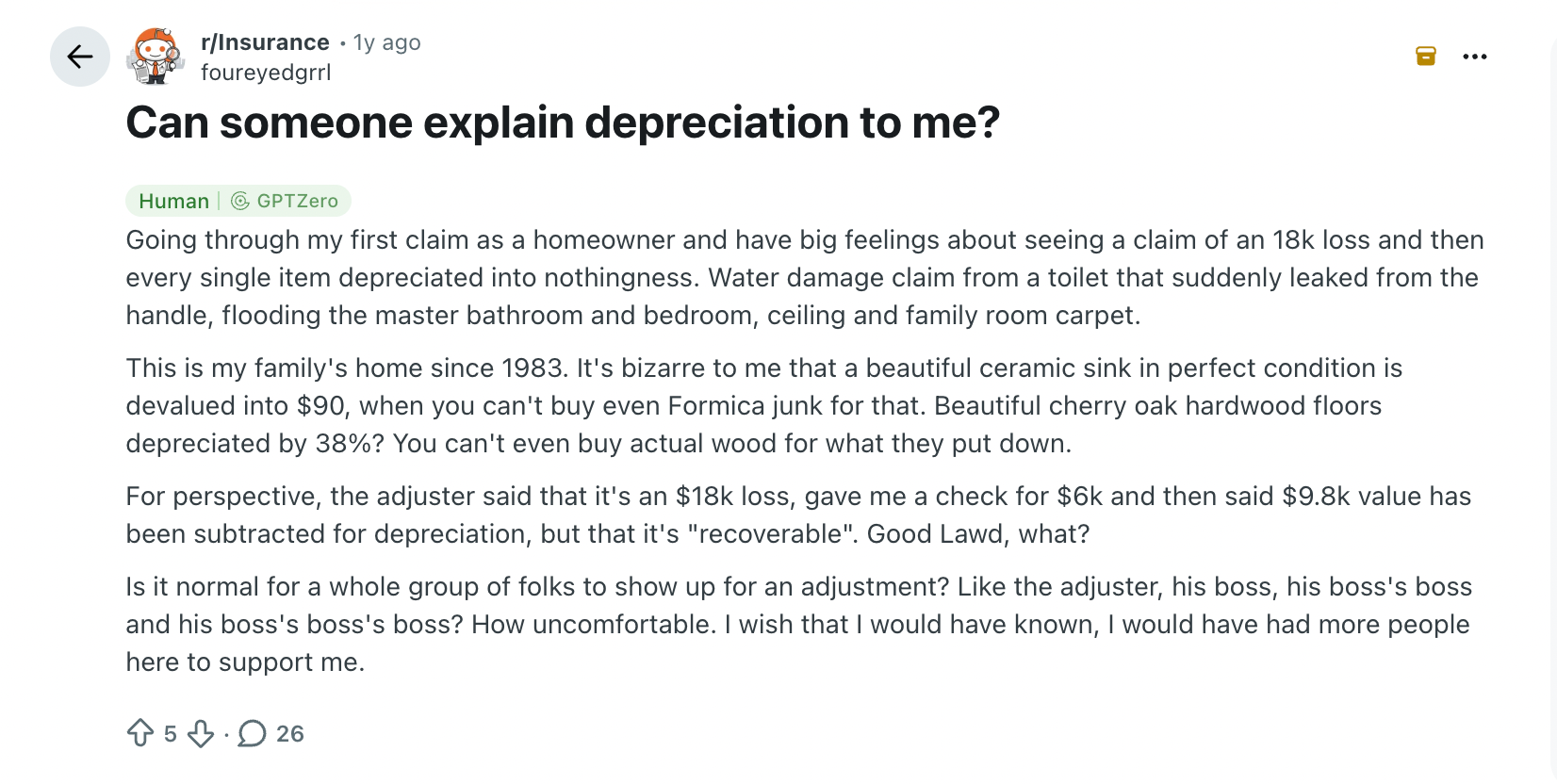
Recoverable depreciation is a common point of confusion for homeowners. They file their claim, get their first check, and don’t realize they might be entitled to a second one but must take extra steps to claim it.
Insurance adjusters aren’t likely to volunteer information about it, either. After all, if the payout process is rarely explained clearly, the carrier can get out of having to pay for your home's recoverable depreciation entirely. So how can you be sure you receive your recoverable depreciation?
Actual Cash Value vs. Replacement Cost Value
When talking about recoverable depreciation, it helps to understand which types of policies allow you to recover the value of your property’s depreciation at all.
Actual cash value (ACV) policies factor in the age and condition of your home when calculating the value of your settlement. That is to say, they deduct the depreciable value of your property from your settlement entirely, and are under no obligation to pay it back. Some states calculate ACV by using replacement cost minus depreciation, while others apply fair market value or the broad evidence rule.
These types of policies are cheaper up front, but—as you can imagine—tend to leave homeowners drowning in out-of-pocket costs when major damage happens. If you have an actual cash value policy, you should not expect to recover any depreciation.
Replacement cost value (RCV) policies cost more upfront because they generally pay to repair or replace with materials of like kind and quality, without deduction for depreciation.
With these types of policies, the age and condition of your home are not factors in depreciation being permanently withheld, but they may still matter. Many RCV policies carry roof surfacing schedules or ACV roof endorsements that pay older roofs on an actual cash value basis regardless of the rest of the policy.
But why are homeowners like the Reddit user above—who have more desirable RCV policies—being handed settlement checks with depreciation deducted from the final amount?
Replacement Cost Payouts: It’s Complicated
According to Merlin Law Group, many insurers only provide policyholders with the depreciated value of a damaged item until they can prove the item has been repaired or replaced.
If you have replacement cost coverage, odds are your carrier is going to still base their initial policy payout based on your home’s depreciated value—just like what happened to the Reddit user above.
It’s only after you have followed through with repairing or replacing your damaged property that your insurance carrier will reimburse you for the remaining replacement cost. This is what is known as recoverable depreciation.
In some cases, carriers may try to depreciate labor as well as materials. This varies by state, with several states prohibiting the practice.
If you don’t follow through on requesting reimbursement for recoverable depreciation, the insurance carrier isn’t obligated to release those funds. Avoid losing out on recoverable depreciation with help from a licensed Public Adjuster.
It’s also important to know that non-recoverable depreciation exists within RCV policies, as well. Certain line items will be depreciated with no path to recovery, so homeowners should not expect for all depreciation under an RCV policy to be recoverable.
Recoverable Depreciation: How To Get That Second Check
If you do have an RCV policy, here’s how to actually receive reimbursement for your recoverable depreciation:
Thought you were out of the woods after your insurer issues the depreciation check? Wrong.
If you have a mortgage on your property, your depreciation check will likely be issued jointly to you and the mortgage company, with funds released in draws as repairs progress. There are additional procedures and
Hire a Public Adjuster
If you’re feeling out of your depths when it comes to pursuing recoverable depreciation, consider hiring a Public Adjuster to advocate for your financial best interests.
A Public Adjuster is a licensed insurance expert who works on behalf of the property owner, not the insurance company. They represent homeowners during the insurance claim process to ensure they’re being treated fairly. Their job is to handle the insurance claim process, which includes damage inspections, claim negotiations, and depreciation reimbursements. Give Tiger Adjusters® a call for help with your RCV policy claim.